
In Part 1 we talked about why power and explosiveness are the first capacities to fade — and why that matters for everyone from competitive masters athletes to women who just want to be able to chase a grandchild around a park at 70 without thinking about it. We also looked at the research gap: how women in midlife and beyond have been chronically underrepresented in the sport science that's supposed to guide our training.
Now let's get practical. How do you actually train explosiveness, speed, and agility in a body that's been around for four, five, six decades — and do it in a way that respects your physiology instead of fighting it?
First, a Definition Worth Pinning Up On The Fridge
Agility is the ability to rapidly change direction, accelerate, or decelerate.
It's not one thing. It's a stack:
Balance — can you stay over your base as forces shift?
Strength — do you have enough force production to drive the change?
Coordination — can your nervous system organize the movement smoothly?
Skill — have you practised the pattern enough that it's automatic under load?
Take away any one of those and agility falls apart. This is why "doing more cardio" doesn't fix it, and why heavy lifting alone doesn't fix it either. The masters athletes who hold onto agility train all four.
The Non-Negotiable Foundation: Strength Comes First
I want to repeat the most important sentence from Part 1, because everything that follows is built on it:
You can't be powerful unless you're also strong.
Plyometrics — the jumping, hopping, bounding work that builds explosiveness — are deeply effective. They're also a tax on the body. If the strength base isn't there, plyometrics turn into either an injury risk or an ineffective workout, sometimes both.
So before we talk about box jumps, the question is: are you currently doing meaningful resistance training at least twice a week, hitting the major movement patterns (squat, hinge, push, pull, carry) with loads that actually challenge you?
If the answer is yes — we can start layering. If the answer is no, that's where we start. Strength is what gives plyometrics somewhere to land.
The Power Tools: Plyometrics and Speed Work
Once the foundation is in place, these are the categories I work with most often for midlife women who want to keep their pop.
Plyometric and explosive work
• Box jumps — onto a box, stepping down (we don't jump down from a height; the eccentric load is unforgiving on aging knees and Achilles).
• Lateral / skier jumps — side-to-side hops over a line, a stick, or onto small targets. This is where most "real life" agility lives — almost no falls happen straight forward.
• Broad jumps — horizontal force production, beautiful for posterior chain power.
• Single-leg hops and bounds — for athletes with the base to handle them. The fact that 9 out of 10 daily movements are single-leg makes these gold.
• Medicine ball throws — slams, chest passes, rotational throws. Upper body explosiveness without the joint load of jumping.
Speed and acceleration work
• Short sprints (10–30 metres) with full recoveries.
• Hill repeats (we'll come back to these in a moment).
• Sled pushes or drags if you have access.
• Bike or rower intervals if running is contraindicated.
Agility patterns
• Cone drills, ladder drills, shuttle runs.
• Reactive agility — having a partner call out a direction so the change comes from a cue, not a plan. This is closer to how agility actually shows up in real life.
The pattern isn't complicated. Strength two to three times a week, intentional power work one to two times a week, and one dedicated speed or agility session. That's enough to move the needle. More than that, for most masters athletes, costs more recovery than it returns.
Cycle-Aware Training: Using the Follicular Phase as Your High-Intensity Window
This is the piece that almost no general training program accounts for, and it's one of the most useful levers you have.
If you're still cycling, the follicular phase of your menstrual cycle — from the start of your period through ovulation — is when your body is generally best primed for high-intensity work.
Want to dig into this more? Check out my online course "Keeping Your Rhythm". I created it exactly to help people with menstrual cycles up-level their performance.
In this window, with rising estrogen and lower progesterone, most women find:
Pain tolerance is higher.
Recovery between hard efforts is faster.
The nervous system feels "snappier" — speed work feels more accessible.
Heart rate responses to intensity tend to be more efficient.
This is your window for the heaviest hitting work:
Speed intervals
Hill repeats
The hardest plyometric sessions
Top-end heart rate intensity
Heavy strength PRs, if that's part of your program
Then, as you move into the luteal phase (post-ovulation through your next period), with rising progesterone, body temperature climbing, and recovery dynamics shifting, you'll typically tolerate longer, steadier, lower-intensity work better than maximal sprints and jumps. Many women find this is a beautiful phase for technique work, longer Zone 2 efforts, and consolidating skills rather than pushing peaks.
A simple way to think about it:
• Follicular phase: chase the ceiling.
• Luteal phase: widen the floor.
For perimenopausal and postmenopausal women:
Cycles become irregular or absent, and the strategy shifts. We pay closer attention to symptoms, sleep, recovery markers, and how the body is responding session to session — and we lean even more heavily on power and strength work, because the protective effects against bone loss, sarcopenia, and falls become more urgent. This is also where individualized care matters most, because the research, as we covered in Part 1, is still catching up.
A Sample Week (One Way to Build It)
This is an example, not a prescription — your program should be built for your goals, your training history, menstrual cycle phases and your phase of life.
• Day 1 — Lower-body strength (squat, hinge, single-leg). Optional: 4–6 box jumps at the start of the session, when the nervous system is fresh.
• Day 2 — Speed or agility session. In the follicular phase, this is where hill repeats or sprint intervals live. In the luteal phase, dial it back to technique and shorter, lower-intensity efforts. But if you’re luteal and love hill training? Go for it, but consider a few less reps or long recovery between sets.
• Day 3 — Upper-body strength (push, pull). Optional: medicine ball throws to start.
• Day 4 — Active recovery (walk, easy bike, yoga, mobility, play with the family).
• Day 5 — Full-body strength with a power emphasis (Olympic lift variations, lateral jumps, broad jumps).
• Day 6 — Longer, lower-intensity aerobic work (Zone 2) which can be incorporated into fun family or friend adventures.
• Day 7 — Rest.
The non-negotiables for masters athletes:
• A real warm-up. Five minutes of light cardio, then dynamic mobility, then a few low-amplitude pop-up movements before any real plyometric work.
• Quality over quantity in plyometrics. Five excellent jumps beat twenty mediocre ones. Stop when the quality drops, not when you're tired. This is true for the whole body and very true for your pelvic floor!
• Recovery you'd be proud of. Sleep, protein, fuel around training. The harder you go, the better you have to recover. This is not optional in midlife.
What to Watch For
Some signs the program is working:
You catch yourself faster when you trip.
Stairs feel snappier.
That first step in a game or trail run has pop again.
Heart rate during intervals is climbing higher than it used to, then recovering faster.
Some signs to back off:
Joint pain that doesn't clear within a day or two.
Sleep disruption that lines up with hard sessions.
Feeling drained, not energized, after speed work.
A run of poor-quality plyometric reps in a row.
The Bigger Picture
The research is finally turning toward women in midlife and beyond. Until it fully catches up, you have to be your own advocate — and the people supporting your training and your health need to be the ones asking your questions, not borrowing them from a 25-year-old's protocol.
Power is the first thing to go. With the right training, it doesn't have to be the first thing lost. The plyometrics, the lateral jumps, the hill repeats, the strength work underneath them, the cycle-aware programming on top of them — these aren't just for athletes. They're for women who want to stay strong, sharp, and fast into the decades ahead.
That's the work. Let's do it.
________________________________________
Dr. Andréa Proulx, ND is a naturopathic doctor practising in Ontario with a focus on healthcare and fitness for active women and masters athletes. This content is educational and is not a substitute for individualized clinical care. If you're new to high-intensity or plyometric training, or if you have a history of joint, bone, or cardiovascular concerns, please work with a qualified clinician or coach before adding these elements to your program.
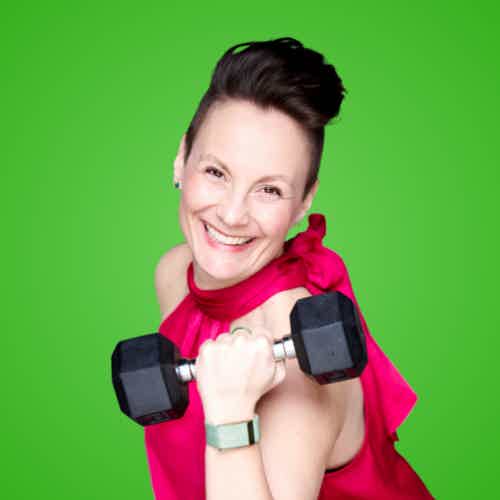
Dr. Andrea Proulx, ND — helping female athletes crush fatigue, fix their hormones, and finally perform like the athlete they know they are. Read full bio